'I'll push you': Man pushes wheelchair-bound friend 500 miles through Pyrenees mountains
Jeffrey Donovan
TODAY contributor
When wheelchair-bound Justin Skeesuck told his best friend,
Patrick Gray, that he’d like to trek a 500-mile ancient route through
the Pyrenees mountains and deserts of northern Spain, the idea seemed
crazy. So too, perhaps, was the best friend’s response.
“I’ll push you,” Gray said.
Skeesuck
and Gray, both 39, are life-long best friends. Born 24 hours apart and
raised in a small Oregon town near the Idaho border, they were best men
at each other’s weddings and still reside blocks from one another
outside Boise. Even their kids — each has three — play together.

Courtesy of Patrick Gray, Justin Skeesuck
Patrick Gray and Justin Skeesuck with a friend as children.
Despite
all of life’s adventures, nothing would have prepared them for El
Camino de Santiago (The Way of St. James), the epic route across a
region celebrated by Ernest Hemingway and for centuries traversed by
pilgrims seeking renewal and redemption.
“It was insane,” Gray
told TODAY.com. “But we proved that even if you have limits in your
life, they don’t have to define who you are. Nothing is impossible.”
Skeesuck,
once a graphic designer for Fortune 500 companies, can no longer move.
Over the years, an autoimmune disease triggered by a car accident has
robbed him of his ability to stand, walk and, recently, to use his upper
body. The disease attacks the nervous system, which responds by
shutting down.

Courtesy of Patrick Gray, Justin Skeesuck
A
self-described “positive person,” Skeesuck felt himself sliding into a
dark depression about two years ago when he lost the use of his arms and
hands.
“It’s very humbling to be in a position where you have to
be bathed, you have to be helped going to the bathroom and having
neighbors come over and pick you up off the floor when you’ve fallen
down,” he told TODAY.com.
“You start to question the purpose of
being here, and I could see that darkness and for the first time knew
how people could get to that point in their lives and just live in that
darkness.”
One rainy, ugly day, a light went on.
“I had
the choice in my life to go down this road — or I could choose to make
the best of it and reshape my life where I could still be an effective
husband and father, where I could still achieve things,” Skeesuck said.
“I chose not to go down that dark road.”
A life-long traveler,
Skeesuck was wondering what to do with his life (now that he couldn’t
use his hands for design work), when a friend mentioned he should help
disabled people learn to travel. So he set off on a “career change.” The
idea of hiking the Camino came after he heard about it on Rick Steve’s
travel show on PBS.

Courtesy of Patrick Gray, Justin Skeesuck
Skeesuck
and Gray set up a website — illpushyou.com — to publicize their
efforts and seek funding. Besides basics, they wanted money for a
trailer in which Skeesuck could promote awareness for his disease and a
four-person documentary crew to film their adventure. They hope to
release a film some time next year if they can get additional funding.
Raw
footage of the trek mixes with shots of Gray, and others met along the
way, pushing Skeesuck across both easy terrain and hellish, muddy paths
up mountains. The trip took five and a half weeks, ending July 12 in the
northwestern city of Santiago de Compostela. The hardest part was on
day two when they crossed from France over the Pyrenees into Spain.
The
4,000-feet ascent climbs for 10 miles, much of it being rocky. Gray and
Ted Hardy, a friend helping for the first days, had to carry Skeesuck
for hundreds of yards. Finally, after reaching the top, “we turned a
corner into a trail covered in mud,” said Gray, a hospital manager.
“It
was awful — the hardest thing I’ve done physically, mentally and
emotionally,” he said. “And then, the next day, the front wheel broke
off Justin’s wheelchair.”

Courtesy of Patrick Gray, Justin Skeesuck
Like
on many occasions on their journey, perfect strangers saved the day. A
Spanish family helped them to a nearby village, where an old man served
coffee and cookies while trying to find a welder to fix the chair. It
was finally fixed in Pamplona and they returned to the trail.
“The
whole point is these people didn’t have to stop. They could have just
keep on walking,” Skeesuck said. “But our journey showed that if you
jump out in faith, then with the help of community and with love,
amazing things happen.”
When they hobbled into the main plaza in
Santiago at journey’s end, they found not only their wives waiting to
greet them — but a crowd of hundreds, many of whom they had just met
along the way, applauding and cheering.
“Seeing my wife was like
being reunited with my soul,” Skeesuck said. “And it was so amazing at
that moment, knowing that all these people loved me and supported me
through this whole thing— complete strangers — and knowing we did it
together.”


 Pozo o fuente de San Indalecio en el lugar del martirio del santo.
  Y la oca, tantas ocas
como 13, un número alquímico. Pero este elemento, este animal, ¿qué
significa? Parece entonces clara la relación con la marca de los
canteros.
Y la oca, tantas ocas
como 13, un número alquímico. Pero este elemento, este animal, ¿qué
significa? Parece entonces clara la relación con la marca de los
canteros.
 Justin e Patrick percorrem trecho do Caminho de Santiago (Foto: Reprodução/ Facebook)
 Justin e Patrick comemoram o final do caminho (Foto: Reprodução/ Facebook)


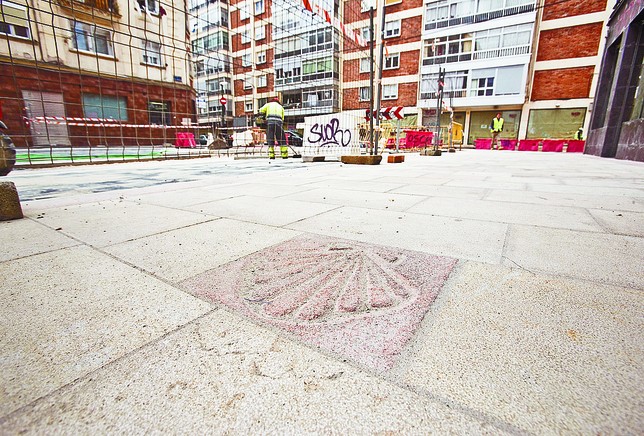 La señalización de la ruta a su paso por la calle Doña Constanza y
otras zonas del barrio ha sido una reivindicación de hace muchos años
realizada por la Asociación de Vecinos Juan XXIII y que ahora ha sido
atendida.
La señalización de la ruta a su paso por la calle Doña Constanza y
otras zonas del barrio ha sido una reivindicación de hace muchos años
realizada por la Asociación de Vecinos Juan XXIII y que ahora ha sido
atendida.

 El regreso
de la talla constituye el primero de varios actos programados, que
culminarán una vez concluya este verano con la reapertura de la Iglesia
tras las obras de restauración que se han llevado en toda su estructura.
En la actualidad se está trabajando en el interior del templo:
acometidas de agua y electricidad, ornamentación, mobiliario, etc.
El regreso
de la talla constituye el primero de varios actos programados, que
culminarán una vez concluya este verano con la reapertura de la Iglesia
tras las obras de restauración que se han llevado en toda su estructura.
En la actualidad se está trabajando en el interior del templo:
acometidas de agua y electricidad, ornamentación, mobiliario, etc.


